
AOS Pro+ vs. SSLX Pro: Choosing the Right All-in-One Solar Light
Featured Products | September 24, 2026 | The Lighting Exchange
Both the AOS Pro+ and SSLX Pro solve the same basic problem — a solar street light that doesn't need trenching or a grid connection — but they solve it with two genuinely different mechanical approaches, and the difference matters more once a project's actual road geometry comes into play.
What you'll find in this article: what separates AOS Pro+'s independently adjustable design from SSLX Pro's integrated approach, which projects favor each, and how to match lumen output to the right model in either line.
An all-in-one solar street light sounds like a single design decision — panel, LED, pole, done. In practice, the two flagship lines in Bullard Solar's catalog take meaningfully different approaches to one specific engineering tradeoff: pointing the solar panel at the sun and pointing the light at the road are rarely the same direction.
How AOS Pro+ handles the aiming problem
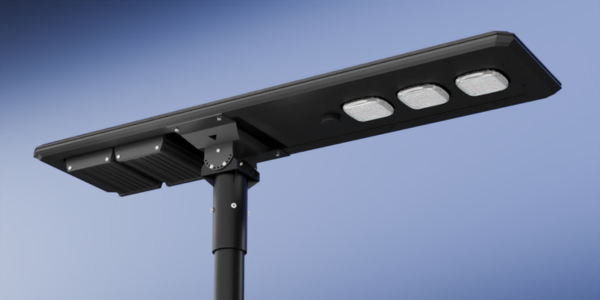
- The solar panel and the LED module adjust independently of each other, rather than moving together as one fixed unit
- This means the panel can be angled for maximum solar capture regardless of which direction the road actually runs, while the LED module aims precisely at the roadway independent of panel orientation
- The tradeoff for that flexibility is a more complex mechanical design, with more adjustment points to set correctly at installation
How SSLX Pro handles the same problem
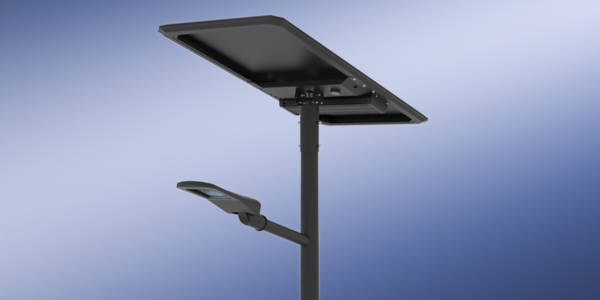
- The solar panel rotates a full 360°, allowing the whole unit to be positioned for maximum sun exposure throughout the day
- Installation is built around speed — mount to a pole, adjust the panel, switch it on, with Bullard citing install times under 30 minutes
- Because the panel rotates independently while the light head stays in a more fixed relative position, this system favors sites where road orientation and optimal panel angle aren't in serious conflict
When the difference actually matters
- On a road running roughly east-west, sun exposure and roadway aim are less likely to conflict, and SSLX Pro's simpler, faster installation is the more practical choice
- On a road running north-south, or on a site with irregular geometry, tree cover, or nearby buildings casting partial shade, AOS Pro+'s independent panel and LED adjustment gives an installer more room to solve both problems separately
- Sites prioritizing fast, high-volume installation across many identical poles — a large parking lot or campus roadway — often favor SSLX Pro's speed advantage at scale
Comparing the lumen ranges
- AOS Pro+ spans roughly 3,920 to 23,520 lumens across its model range (Pro+ 20 through Pro+ 120)
- SSLX Pro spans roughly 5,580 to 23,520 lumens across its range, including a Dual 50 configuration producing 2×19,600 lumens for wider-coverage applications
- Both lines overlap significantly in output, so model selection should be driven primarily by the aiming and installation considerations above, not lumen output alone
What a specifier should know
- Both lines share the same core feature set: lifetime warranty coverage, corrosion resistance, UV-stabilized materials, Class II double insulation, and resistance to chemical fertilizers common near landscaped roadways
- Pole height ranges from roughly 118 to 236 inches across both lines, in modern and classic pole styles
- Neither system requires trenching or a grid connection — the real decision is mechanical design and installation speed, not power source
Choosing between these two lines isn't about picking the "better" solar light — it's about matching the mechanical approach to the specific geometry and installation priorities of the actual site.
FAQ
Is AOS Pro+ more expensive than SSLX Pro? Generally, more complex adjustment mechanisms carry a cost premium, so AOS Pro+ typically runs higher than an equivalent-output SSLX Pro model — that premium buys flexibility for sites where panel and road orientation genuinely conflict.
Can SSLX Pro's 360° rotation solve the same problem as AOS Pro+'s independent adjustment? Partially — 360° panel rotation solves for sun exposure across the day, but the light head's aim moves less independently of the panel than in AOS Pro+, which is the real distinction between the two systems.
Which line installs faster? SSLX Pro is specifically engineered for fast installation, with Bullard citing sub-30-minute install times; AOS Pro+'s additional independent adjustment points generally add some installation time, though both remain far faster than trenched, grid-connected alternatives.
Do both lines offer the same lumen range? They overlap substantially — both span from roughly 3,900 to over 23,000 lumens across their model ranges, so lumen output alone isn't the deciding factor between them.
Which line is better for a north-south road? AOS Pro+'s independently adjustable panel and LED module generally give more flexibility on roads where the sun's path and the road's orientation don't naturally align.
Other News Content by:
Bullard Solar
Why We Build With Lithium — And Why It Matters
Featured Products | August 18, 2026 | The Lighting ExchangeWhy Adjustable LED Solar Lights Outperform Fixed Systems
Industry Topics | July 10, 2026 | The Lighting Exchange